Zentgraf House Tour Program, 2008
EDC Photo
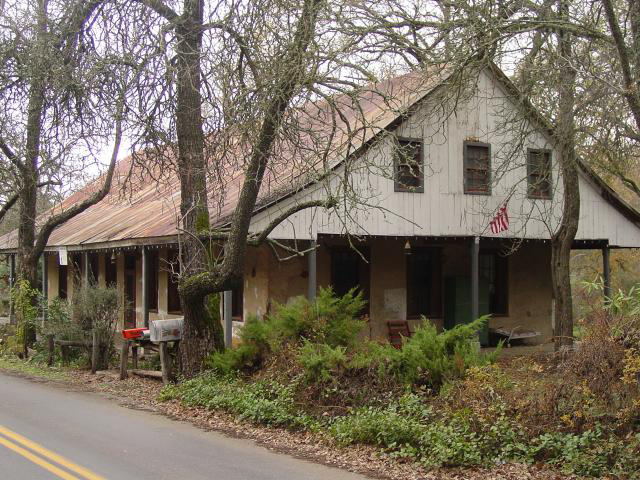
Zentgraf House Today
HISTORICAL
ZENTGRAF HOUSE
OPEN HOUSE AND WINE CELLAR TOUR SEPTEMBER 13, 2008 12 NOON to 3:00 PM
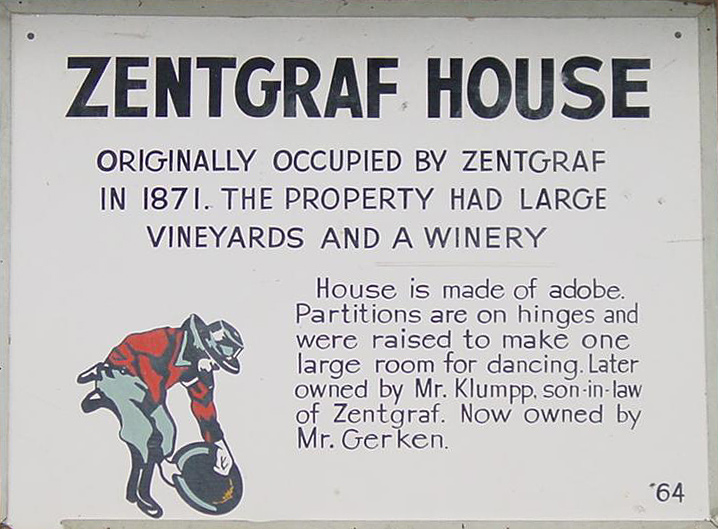
Zentgraf House Historical Plaque
Welcome to the Zentgraf House. The Clarksville Region Historical Society is pleased to host this special event for our Society members and invited guests.
The goals of the Society are to identify and preserve documents, artifacts, re-cords, and other objects of historical interest related to historic Clarksville and the surrounding region for its residents and the public; to educate the public and increase public awareness of the historical significance of historic Clarksville and the surrounding region; and to enlist public support for the historical preservation and display of documents, arti-facts, records, and other objects of historical interest related to historic Clarksville and the surrounding region. The preservation and restoration of the Zentgraf property is one of the goals of the Society. Your generous tax-deductible contributions will help us achieve the goals of the Society.
We would like to extend our warm thanks to the present owners, the Gerkin family and Gerkin descendant Jack Schafer, who graciously opened the house and wine cellar for this event, and also Zentgraf descendant Tom Stewart.
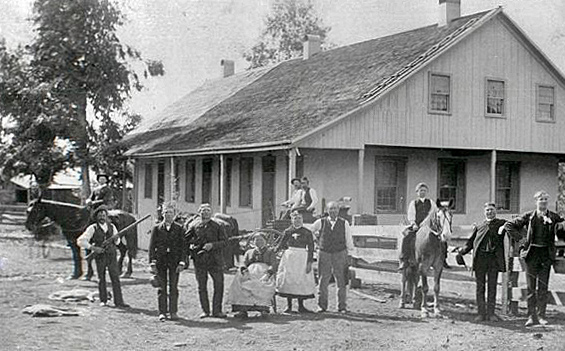
The Zentgraf Family in 1888 Maria Zentgraf is seated, with her daughter Mary standing by her side
ZENTGRAF HOUSE
According to author Paolo Sioli*, Jacob Zentgraf was born in Saxe-Weimar- Eisnach, Germany, August 12, 1821, the son of George and Mary Zentgraf, who were natives of the same place. When Jacob was 16 years old he learned the stone-cutting trade from his father. Jacob continued to work at his trade in Germany until he emigrated to the United States in 1852.
Jacob first settled for a few months in Butler, Pennsylvania. In 1853 he came to California via Nicaragua route, landed at San Francisco on December 11th of the same year, and began mining on Weber Creek.
In the fall of 1854 Jacob and his brother Antone bought what is now known as the Zentgraf property. A Mr. Stevens had planted thirty-two grape vines on the place in 1849, and Jacob proceeded to set out additional vines. According to Sioli, all the other nearby vineyards of early days were furnished from it.
In 1857 Jacob bought out his brother, the farm then consisting of about 520 acres of land on which there was an abundance of water. So much water that, in 1926, Jacob’s son-in-law, Louis Klumpp, who married Johanna Zentgraf, successfully resisted an attempt by a neighbor, J.T. Ramsay, to appropriate some of the water that flowed from the Zentgraf spring that arose near the house and flowed into Sweetwater Creek.
Jacob married Maria Fischer, a native of Germany, in August of 1858. They had nine children: seven sons, George, John, Gabriel, William, Lambert, Jacob, and Frank; and two daughters, Johanna (or Hanna) and Mary. None of the sons had sons of their own, so the Zentgraf name was not carried on in the family.
Author Joanne Burkett recounts that when Jacob built the Zentgraf house in 1871, the outer walls were more than a foot thick. Inside walls were hung loosely from the ceiling by hooks. This arrangement made it a simple chore to swing the walls up and attach them to the ceiling with more hooks, thereby effectively turning the house into a hall that could then be used for parties and dances. The Zent-graf house became the area’s gathering spot, and folks came from miles around to attend the dances that took place under its roof.
The 1880 U.S. Census for White Oak Township (as the locale was then known) lists eleven Zentgrafs living in the house: Jacob, then 60 years old; Maria, 43; George, 21; John, 19; Gabriel, 19; Johanna, 16; William, 13; Lambert, 11; Jacob, 9; Mary, 7; and Frank, 6. Jacob gives his occupation as “Farmer,” his wife Maria as “Keeping House,” with the occupations of the sons and daughters variously described as “Farmer,” “At Home,” “At School,” with no entries for the three youngest children. George M. Zentgraf is listed as the Enumerator of Enumeration District 23 at the top of the census page.
The 1900 El Dorado County Precinct Register shows eight Zentgraf men whose address was “Green Valley” eligible to vote (recall that the 19th Amendment was not passed until 1920): Jacob, age 80; George F., 42; John, 40; Gabriel, 39; William, 36; Lambert, 34; Jacob H., 31; and. Frank, 25.
The 1910 U.S. Census shows five Zentgrafs living in the house: Jacob Sr., age 88; John, 48; Gabriel, 46; Jacob H., 38; and Frank J., 34. Jacob Sr. lists his occupation as “None,” while his sons list their occupations as “Miner.”
In the 1920 U.S. Census, the only Zentgraf shown living at the house was Jacob H. Zentgraf, age 48.
Jacob H. Zentgraf sold the property to the Gerkin family in 1941. He continued to live on the property until 1948, when failing health led him to live with his sister Johanna, and he died soon thereafter.
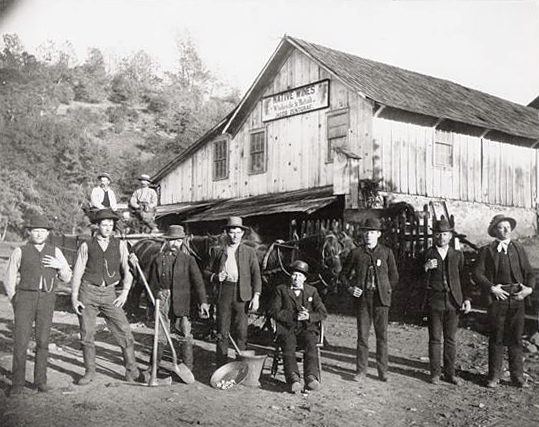
The Zentgraf Winery during its operation. The sign on the winery reads “Native Wines - Wholesale & Retail - Jacob Zentgraf”
THE ZENTGRAF WINERY
Paolo Sioli reports that in 1857 Jacob Zentgraf’s winery produced 1,800 gallons of wine that was sold for $1.50 per gallon. He states that: “Mr. Jacob Zentgraf, on Sweetwater Creek, Green Valley, keeps one of the oldest vineyards in the county, which he has endeavored to enlarge and improve considerably every year.”
Sioli also says that Jacob set up a small distillery in 1859 to make brandy that he sold for $2.50 per gallon, and that the winery produced from twelve to fourteen barrels of brandy and made from four to six thousand gallons of wine. Tax records from 1866 show that Jacob Zentgraf paid a $10.00 excise tax on his distillery operations in December of that year.
Due to the prosperity of his vineyards, in 1871 Jacob was able to afford to build Zentgraf House, his luxurious adobe home which still stands today. At present the house and the wine cellar are split across both sides of Deer Valley Road in El Dorado County, but neither the vineyard nor the winery have survived.
*Sioli, Paolo. “Historical Souvenir of El Dorado County California with
Illustrations & Biographical Sketches of its Prominent Men & Pioneers,”
Oakland, Cal. (1883).
Note: The historical information in this brochure is taken from sources generally believed to be accurate, but the Society cannot be responsible for any
inadvertent errors or omissions.
The Clarksville Region Historical Society is a 501(c)(3) non-profit
organization in El Dorado Hills, California. Contributions to the Society are
tax-deductible. Inquiries about the Society or Society membership may be
directed to Hal Erpenbeck, President, at 530-677-3355, or visit the Society’s
website, www.edhhistory.org.